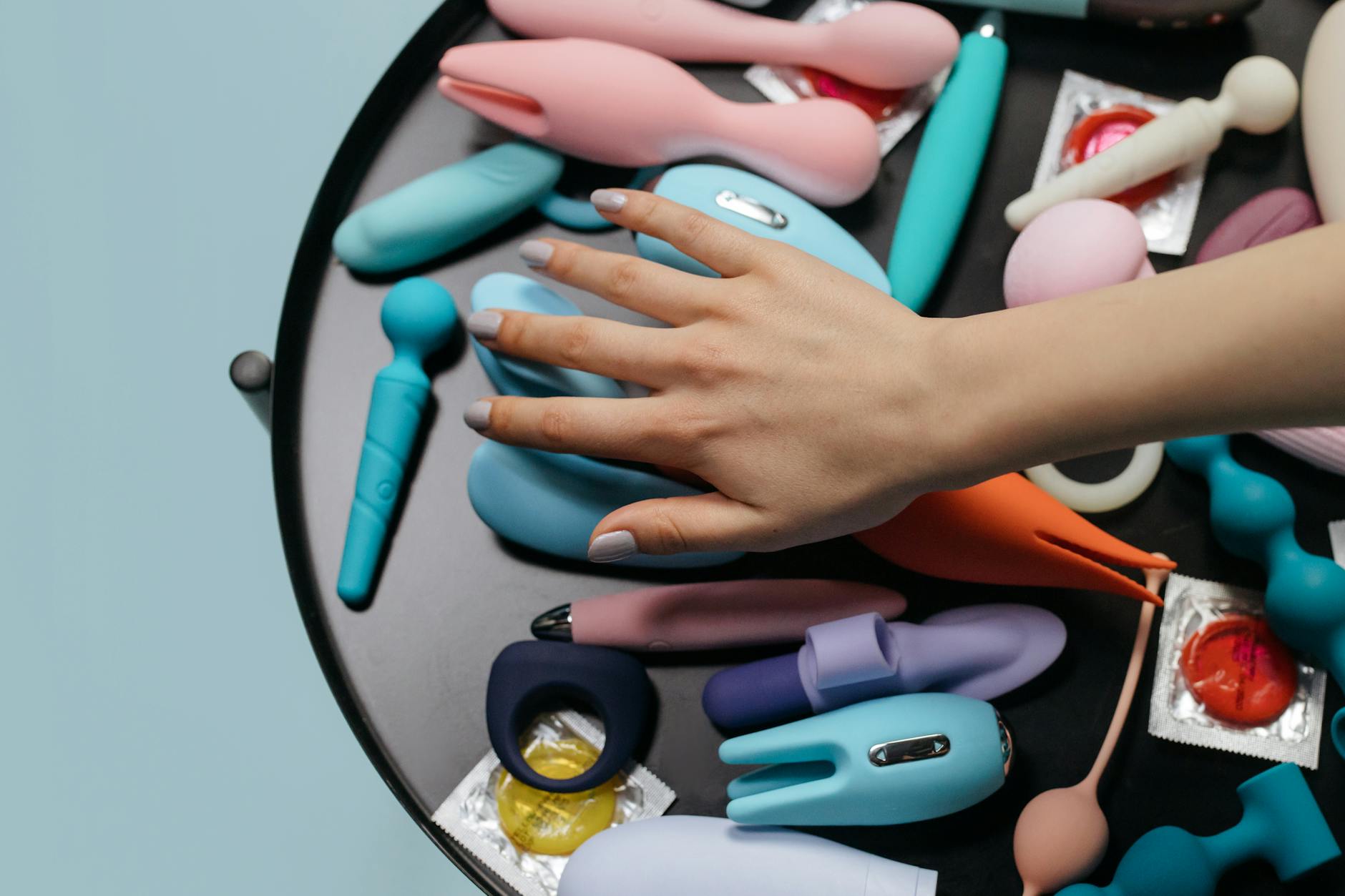
Let's talk about the numbness you're experiencing
Antidepressants are often worth taking. They're also often worth grieving. One of the things nobody warns you about when you start SSRIs or SNRIs is that sensation in your clitoris can flatten completely. Not every person, not every medication, and not permanently. But it happens enough that I hear about it constantly in my practice.
Here's what's important: the numbness is real, it's not in your head, and it's absolutely reversible. More importantly, there are specific tools like lemon clitoral vibrators that work differently enough that they can reach sensation even when nothing else does.
What antidepressants actually do to your nerve endings
SSRIs and SNRIs work by changing how serotonin moves through your nervous system. That's helpful for your mood. It's less helpful for the delicate sensory cascade that happens in your clitoris. Here's the chain of events:
Your clitoris has roughly 8,000 nerve endings packed into a few square centimeters. That density is what allows for exquisite sensation. Antidepressants don't destroy those nerve endings. Instead, they dampen how quickly signals travel between them. It's like the volume on sensation gets turned down, not off.
That's different from hormonal numbness, which we see with hormonal birth control or menopause. And it's different from psychological numbness, where desire itself disappears. With antidepressants, your clitoris is still there, fully innervated, but the electrical signals moving through it move slower and fainter.
The good news: nerve speed and signal strength are not permanent settings. They adapt. And certain types of stimulation can adapt them faster.
Why standard vibrators often don't work when antidepressants have dampened sensation
Most vibrators work through direct mechanical vibration. They buzz at a certain frequency, and your nerve endings respond to that frequency. But if the medications you're taking have slowed your nerve signal transmission, a standard vibrator might be vibrating at a frequency your nerves can't quite pick up fast enough.
It's like someone whispering when you need a louder voice to hear them. The volume is there, but not enough contrast.
Lemon clitoral vibrators work differently. They use suction instead of (or in addition to) vibration. Suction creates a pressure differential. It pulls tissue upward and inward, which stimulates not just the nerve endings at the surface but the deeper nerves inside the clitoral body as well. That multi-layered approach often bypasses the transmission slowdown that antidepressants create.
It's not magic. It's physics. And it's why so many people on antidepressants find that lemon vibrators work when traditional vibrators didn't.
How suction reaches sensation that vibration misses
Your clitoris is not just the visible bud. It's an entire organ, roughly the size and shape of a wishbone. Most of it is internal, under the skin and fascia. The visible tip is the glans. The hidden part includes two branches that curve backward toward your pelvis.
When a lemon suction vibrator creates that pulling sensation, it engages the entire structure. The pressure wave travels deeper into the tissue than surface vibration alone can reach. That means you're accessing nerve endings at multiple depths and in multiple orientations.
For people whose clitoral sensation has been flattened by antidepressants, that multi-depth approach is often the difference between feeling nothing and feeling everything.
Starting slow when you've been numb for months
Here's what I tell clients: your clitoris hasn't forgotten how to feel. But it's been in a kind of sensory sleep. You can't wake up a sleeping limb by shaking it hard. You wake it up gently.
Start with the lowest suction setting on your lemon vibrator. I mean the very lowest. Spend 5 to 10 minutes just letting your clitoris adjust to the sensation. You might feel nothing on day one. That's normal. On day two, you might notice a faint tingling. By day five, you might notice a real pull sensation.
This isn't about achieving an orgasm yet. This is about rehabilitation. You're teaching your clitoris and the associated nerve pathways to wake up again.
Most people I work with who start this way report restored full sensation within 2 to 4 weeks. Some faster. Some a bit slower. But the trajectory is almost always upward once you start.
The role of lube, warmth, and a body that's actually ready
If you've been numb on antidepressants for a while, you might not be producing as much natural lubrication. That's partly medication, partly neural dampening, partly just that your body isn't getting the early-stage arousal signals that usually trigger lubrication. The result is that your clitoris feels dry and maybe even a bit raw.
Use water-based lube. Not because you're broken, but because dry tissue against suction can feel like friction rather than pleasure. The lube creates a seal and makes the suction sensation smoother.
Warmth also helps. A lemon clitoral vibrator after a warm shower or bath is genuinely more effective than one used in a cold room. Heat increases blood flow to the area, which increases sensation and makes nerve signals travel slightly faster.
And timing matters. Don't try to wake up your clitoris when you're stressed, distracted, or just powering through. Your nervous system has to be somewhat regulated for sensation to come back online. That means 10 to 15 minutes of actual relaxation before you start. Not rushing.
When medication adjustment might actually be worth discussing
If you've been on the same antidepressant for months and sensation hasn't come back at all, talk to your prescriber. Some antidepressants have less impact on sexual sensation than others. Bupropion (Wellbutrin) and mirtazapine are historically gentler on sexual function. Paroxetine (Paxil) is historically harder on it.
Swapping medications isn't always the right call. Your current medication might be working for your mood in a way another one won't. But it's worth the conversation. And it's worth knowing that sexual side effects are a legitimate reason to consider a change if your depression is already stable.
In the meantime, devices like lemon vibrators can help you function sexually even while you're on a medication that dampens sensation. You're not waiting passively. You're working with your body.
The timeline for getting sensation back
Let's be real about expectations. If you've been numb for a year on antidepressants, you're not going to have volcano orgasms on week one with a new tool. But you will likely notice something shift in the first 2 to 3 weeks if you're using a lemon clitoral vibrator consistently.
Week 1 to 2: Maybe tingling. Maybe just pressure without much sensation. That's progress.
Week 3 to 4: Actual pleasure signals starting to register. The device might start to feel good rather than just neutral.
Week 5 to 8: Orgasm becoming possible again. Usually a different quality than pre-medication orgasms. Often deeper, slower to build, but more whole-body.
Week 8 onwards: Sensation continuing to normalize. The more you use the device, the faster your nervous system re-tunes.
None of this is guaranteed. Biology varies wildly. But this is the most common timeline I see in my practice.
Why the lem vibrator specifically works for antidepressant-dulled sensation
The Lem by Buy Lemon Clit is specifically engineered for penetrative and external use, but it's particularly effective for this because of how its suction patterns are designed. It pulses rather than just holds suction, which creates a rhythm that your dampened nerve endings can latch onto more easily than constant vibration alone.
That pulsing pattern mimics the natural rhythm of arousal, which helps your nervous system remember what it's supposed to be doing. It's not novel stimulation. It's familiar stimulation delivered in a way that bypasses the specific dampening that antidepressants create.
You don't need the most expensive device. You need the right mechanism. And for antidepressant-dulled sensation, suction beats vibration almost every time.
What to do if even suction isn't working
If you've given it six weeks, you're using lube, you're relaxed, and you still feel nothing, a few things are worth checking:
First, make sure your antidepressant dose is stable and hasn't been increased recently. A dose increase can reset the numbness clock.
Second, check if anything else is contributing. Are you stressed? Sleep-deprived? Drinking a lot? All of those dull sensation further.
Third, consider whether the numbness is actually sexual or whether your desire itself has disappeared. Those are different problems requiring different solutions. If you have no desire at all, that might be worth a medication conversation. If you have desire but no sensation, external tools plus time usually do the job.
Finally, if nothing is working after three months, talk to a sex therapist or your prescriber about whether it's worth reconsidering your medication. Your mental health is non-negotiable. But so is your sexuality. Sometimes finding the right medication means exploring that conversation.
FAQ: Your actual questions about antidepressants and clitoral sensitivity
How long does antidepressant numbness usually last if I don't do anything about it?
Without intervention, it often doesn't improve much, unfortunately. Some people adjust to it. Some people's bodies naturally adapt over months. But if you're actively working with tools like a lemon vibrator to retrain sensation, you'll see improvement faster than if you just wait. Waiting can actually entrench the numbness because your nerve pathways get less practice signaling.
Can I use a lemon vibrator if I'm also on birth control that dampens sensation?
Absolutely. Actually, the combination is more common than you'd think. The suction mechanism works regardless of what other hormones or medications are in your system. If anything, you might need to spend a bit more time on the lowest settings to wake up sensation. But the mechanism still works.
Does cycling off antidepressants bring sensation back faster?
I'm going to be direct: do not stop taking antidepressants to fix sexual side effects without talking to your prescriber. Depression returning is worse than numbness. That said, if you're already planning to come off them for other reasons, yes, sensation usually returns within a few weeks once the medication is out of your system. If you're staying on them, working with suction-based devices is your best bet.
What if I have sensation but I've lost the ability to orgasm entirely?
That's a different issue from numbness, though they can happen together. If you can feel but can't finish, you might need to slow down, breathe differently, or use a different stimulation pattern. A therapist can help you troubleshoot that. The lemon vibrator is still useful because it gives you a wider range of stimulation to work with while you're relearning your body.
Is the numbness permanent if I stay on antidepressants long-term?
No. Some of it is, but most people adapt. What often happens is that sensation gets duller in the first 2 to 3 months, then your body adjusts and partially recalibrates. It's rarely the same as pre-medication, but it's usually functional. Adding a tool like a lemon clitoral vibrator helps speed up that recalibration.
Can I use a lemon vibrator if I also have vaginal dryness from the antidepressants?
Yes. In fact, it's ideal. Suction-based stimulation combined with water-based lube is often more comfortable for dry tissue than other types of stimulation. Start slow, use plenty of lube, and let your body warm up. The combination usually works really well.
The bottom line
Antidepressants save lives. They also sometimes flatten sexuality in the process. That doesn't mean you have to accept permanent numbness or choose between your mental health and your sexual pleasure. Tools like lemon clitoral vibrators work through a different mechanism than standard vibrators, which means they can reach sensation even when your antidepressants have dampened your nervous system's response.
Start low, be patient, use lube, and give your clitoris time to wake up. Six weeks of consistent, gentle use usually shows real improvement. And if it's not working after that, it's worth revisiting your medication conversation with your prescriber.
Your pleasure matters. Your mental health matters. You don't have to sacrifice one for the other.
If you're struggling to find the right approach for your body, we're here to help. Reach out at /contact and let's figure out what's going to work for you.